

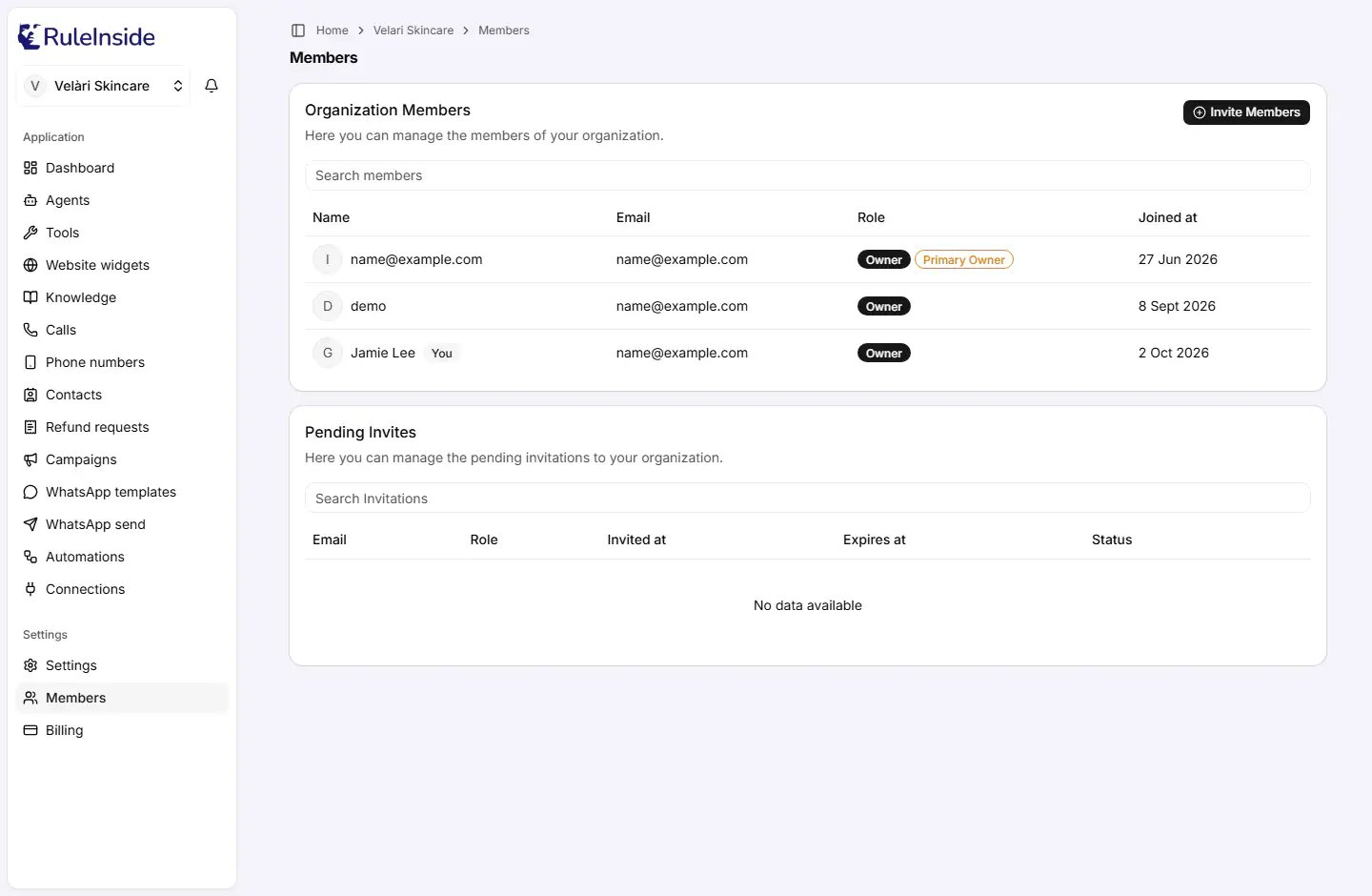
The Members page: your team at the top, pending invitations below.
Organization Members
The first card, Organization Members, lists everyone with access. Search members filters the list as you type. It matches a person’s name and their role (typeowner to see
the owners), and ignores upper and lower case. It does not match the part of an email after the @.
Owners are listed before members. When there is nobody to show, the table reads No data available.
The actions menu
The … button at the end of a row opens the actions you are allowed to take on that person. It never appears on your own row or on the primary owner’s row, and it does not appear at all if you may take none of the actions.Inviting people
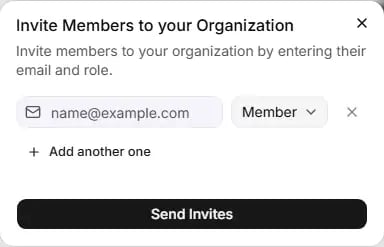
Invite up to five people at a time, each with their own role.
1
Open the dialog
Click Invite Members. The dialog Invite Members to your Organization opens. It may show “Loading.
Please wait…” for a moment first.
2
Add each person
Type the person’s email and choose their role. Click Add another one for each extra person, up to 5 in one
go. Remove a row with its X button (Remove invite).
3
Send
Click Send Invites. You see “Members invited successfully”, and each person receives an email with a link
to join.
Good to know:
- The same address twice in one form is refused with “Duplicate emails are not allowed”.
- If any address in the form already belongs to a member of your organization, the whole form is refused and nobody is invited. You see “Sorry, members could not be invited. Please try again.” Take that address out and send again.
- An address that already has a pending invitation to your organization cannot be invited again. Remove the old invitation first, or renew it if it has expired.
- An invitation is valid for 7 days.
- The person must accept with the same email you invited (upper and lower case do not matter). If they sign in with a different address, the link tells them the invitation was not found. See Accepting an invitation.
Pending Invites
The second card, Pending Invites, lists invitations that have not been accepted yet. Everyone can see it. Search Invitations matches the part of the email before the@, and the role.
An accepted invitation disappears from the list. An expired one stays until someone renews or removes it.
Managing an invitation
Owners see a … menu on each invitation. Members do not.- Update Invitation changes the role the person will get. The dialog is titled Update Member’s Role, and you save with Update Role.
- Renew Invitation appears only on an Expired invitation. It makes the link the person already has work again for 7 days from now. It does not send a new email: tell the person to use the email they already received.
- Remove Invitation opens Delete Invitation. Press Delete Invitation to confirm. The emailed link stops working at once. This cannot be undone: to let the person in later, invite them again.
Only the primary owner can change or renew an invitation for the Owner role, or turn a member invitation
into an owner one. Any other owner manages member invitations only.
Changing someone’s role
1
Open Update Role
On the person’s row, open the … menu and choose Update Role. The dialog Update Member’s Role
opens.
2
Pick the new role
In Role, choose Owner or Member. Their current role is greyed out. Picking the same role shows
“Role must be different from the current one”.
3
Save
Click Update Role, or Cancel to close without saving.
Removing someone
On the person’s row, open the … menu and choose Remove from Account. The dialog You are removing this user asks you to confirm. Click Remove User from Organization.- The person loses access to this organization straight away.
- Their login is not deleted. They can still sign in, and they keep any other organizations they belong to.
- To bring them back, invite them again.
- The primary owner cannot be removed.
Transferring ownership
Only the primary owner can do this. Use it to hand the organization to someone else, or before you leave or delete your own login.1
Choose the person
On their row, open the … menu and choose Transfer Ownership.
2
Prove it is you
Click Send Verification Code. We email a 6-digit code to your own address. Type it in and click
Verify Code. If the email does not arrive, click Request New Code. You get at most 5 tries per code.
3
Confirm
A red box names the person you are transferring to. Click Transfer Ownership to finish, or Cancel to
stop.
- The person you chose becomes the primary owner, and gets the Owner role if they did not have it.
- You keep the Owner role and stay in the organization. You can now leave it if you wish.
- Only the new primary owner can transfer ownership back.
Common questions
I invited someone and they never got the email.
I invited someone and they never got the email.
Ask them to check their junk folder first. If the email still has not arrived, remove the invitation and invite
them again. There is no resend button, and Renew Invitation does not send an email.
The invitation link shows 'Invite not found or expired' or a page that cannot be found.
The invitation link shows 'Invite not found or expired' or a page that cannot be found.
The invitation is more than 7 days old, was removed, or was already used. It also happens when the person signs
in with a different email from the one you invited. If the invitation shows Expired, an owner can click
Renew Invitation and the same link works again. Otherwise, invite the address they actually sign in with.
Can a member invite people?
Can a member invite people?
Yes, but only with the Member role. Members cannot change or remove invitations afterwards.
How do I hand the business over to someone else?
How do I hand the business over to someone else?
As primary owner, use Transfer Ownership (you will need the emailed code). Afterwards you can leave from
Organization settings.
Is there a limit on members, or does each member cost extra?
Is there a limit on members, or does each member cost extra?
No limit, and no extra cost. No plan is billed per person.
I removed someone by mistake.
I removed someone by mistake.
Invite them again. Their login still exists, so they can accept straight away.