

The ways to test
Talk to your agent with Preview
Preview is the quickest test: it runs in your browser and needs no phone.1
Save your changes first
Preview uses the agent’s saved settings. If you changed something, click Save changes in the bar at the
bottom of the editor before you start.
2
Open Preview
Open Agents and click Preview in the editor header. Only owners see the button.
3
Choose Text or Voice
Click Text or Voice, then Start text chat or Start voice call. For voice, your browser asks to
use your microphone. The status moves from “Not connected” to “Connecting…” and “Connected”.
4
Have a real conversation
Ask what your customers ask. In voice, just talk: the panel shows “Agent is speaking…” or “Listening, just talk”.
5
End
Click End, or close the panel.
- It is the real agent: its greeting, voice, instructions, knowledge and tools.
- It does not identify you as a customer. Store tools answer as they would for a guest: an order’s details are given only when you say its order number together with the billing email and postcode on that order. Test order look-up for a signed-in customer on your website instead (see below).
- We recommend testing in Voice at least once. Text shows what the agent says; only voice shows how it sounds, how quickly it answers and how it handles interruptions.
Test the website assistant
In the widget editor
Open Website widgets and click the pencil on a widget. The Live preview on the right is the real widget, updated a moment after each change you make in the editor.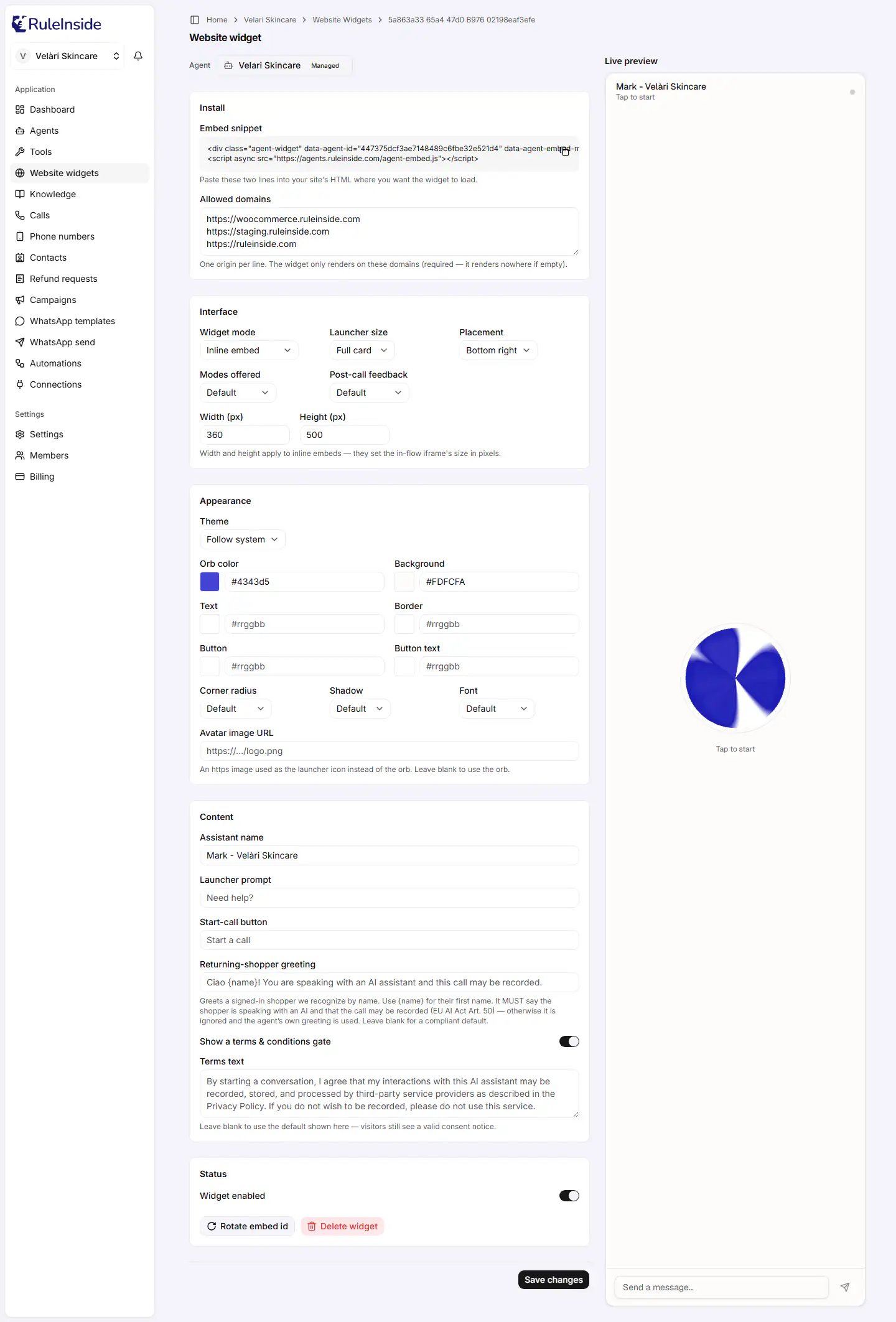
The widget editor, with the live preview on the right.
- It is a real conversation with your agent. Your browser asks for the microphone, and messages you type are really sent.
- Like a conversation on your website, it needs the widget switched on, your account active and on a paid plan, and it counts towards your daily conversation limit.
- Width (px) and Height (px) are not shown in the preview.
- The preview shows your changes before you save, but your website does not change until you click Save changes.
On a copy of your site
If you have a staging copy of your store, we recommend trying the widget there before your live site:- Add the staging site’s address, starting with
https://, on its own line in Allowed domains, and click Save changes. The widget only appears on the addresses listed there. (http://is accepted only forlocalhostaddresses on your own computer.) - Paste the snippet into the staging site or, on WordPress with the RuleInside plugin, paste the embed id into the plugin’s Widget ID field (WordPress admin, menu RuleInside).
- Open the staging site as a shopper would and start a conversation.
As a signed-in customer and as a guest
Your assistant gives order details to a customer logged in to your store, about their own orders. Someone not logged in gets an order’s details only by giving its order number together with the billing email and postcode on that order; otherwise, general help. Try both:- Signed in: log in to your store as a customer who has an order (a test account of your own is ideal) and ask about that order. In a voice conversation, a signed-in shopper your store recognises is greeted with the Returning-shopper greeting, as long as it mentions both AI and recording.
- As a guest: log out, ask the same question without giving the billing email and postcode, and check that no order details are given.
Call your own phone number
1
Check who answers
Open Phone numbers. The number’s Inbound agent must show an agent: a dash means no agent answers calls to
it. Press Assign to choose one.
2
Call it from your mobile
Listen to the greeting from start to end.
3
Try the hard moments
We suggest you interrupt the agent, say “ok” while it talks, spell an order number or an email address, stay
silent for a while, and, if transfers are set up, ask to speak to a person.
4
Find the call
Open Calls, choose the agent in the Agent bar, and look for a Phone inbound call from your number.
Its summary and outcome appear a short time after the call ends: refresh if they are missing.
Place a campaign test call
A campaign can call your own phones before it calls anyone else. Test calls are for phone campaigns only.1
Create a draft
Click New campaign, choose Phone call, and fill in the campaign as you mean to run it. Creating it only
saves a draft: nobody is called.
2
Add your test numbers
In Test numbers (optional), type your own numbers, one per line, in international format such as
+15551234567. Up to 20.3
Send the test call
Open the campaign and click Send test call, then Place test call. The campaign stays a draft.
Send yourself a WhatsApp message
WhatsApp campaigns have no test call. To test a template, send it to your own number from WhatsApp send. Before you start, check that:- your WhatsApp number is connected on Phone numbers (for a number our team connected for you, with Messaging enabled on and an agent assigned);
- the template is registered under WhatsApp templates with Kind set to Message and Enabled on;
- you are a saved contact, with your number in international format starting with
+, and WhatsApp consent is recorded on your contact with Consent (see Contacts); - an owner has confirmed Settings › Calling consent.
1
Fill in the form
On WhatsApp send, type your number in To (phone number), choose the Template, and fill in any
Template variables.
2
Send
Click Send message, then Send now in the confirmation.
3
Check the result
Look at your row in Recent sends. Status shows where the message is; Delivery shows what WhatsApp
reported, for a number connected through Meta.
- A Marketing template is sent only inside the calling hours where you are. Outside them it waits as Queued.
- A number that is not a saved contact is refused, and the send log shows Suppressed with
opt_out. - If you reply STOP from your test phone, you opt yourself out of WhatsApp messages and calls from your store. Reply START to opt back in to WhatsApp messages (calls stay stopped).
Pre-launch checklist
Work through this list before real customers can reach your agent.Reading a test conversation
Open Calls, choose the agent, and click the date of your test call. The call’s page shows, from top to bottom:- Recording: listen to the greeting and the agent’s voice as a customer heard them.
- Details: the channel, the duration and the Result (Success or Failure).
- Summary and Data collected: what the agent understood and captured, for example a lead’s email.
- Evaluation: each check your agent runs, with its result and explanation, when your agent has any.
- Transcript: the whole conversation, message by message.
- Slow answers. The figure after an agent message’s time, such as ”· 1.41s”, is how long the agent took to respond. If answers feel slow, see Turn taking.
- Interruptions. interrupted marks a message that was cut off. If the agent stops when the caller says “ok”, add those words to Words that do not interrupt.
- Actions. Rows with a wrench icon are actions the agent took, such as looking up an order, with “ok” or “error”. Open one to see Request and Response.
- Knowledge look-ups. A row with a book icon shows the agent checked your knowledge. If it never checks a document you expected, see How the agent uses a document.
A suggested way to roll out
You do not have to switch everything on at once. A careful order, which we recommend:- Website first. Try the widget on a staging copy, then add your live address to Allowed domains. To stop it at any time, switch Widget enabled off and click Save changes: your snippet does not need to change.
- Your phone line. Assign the Inbound agent and read the Calls page every day for the first week.
- A small campaign. Upload a short list of people who agreed to be called, launch, and read the launch result and every call before you reach a larger group. An uploaded list holds at most 1,000 rows, and a campaign reaches at most 5,000 contacts.
- Automations last. Use Preview on a rule to see who it would reach (it never places a call), and keep one rule switched on at a time.
- WhatsApp. Send a template to yourself, then to a small group.
Common questions
Preview doesn't use the change I just made.
Preview doesn't use the change I just made.
Preview uses the saved settings. Click Save changes, then start a new Preview.
Why can't I see Preview?
Why can't I see Preview?
Only account owners see it. Ask an owner of your team.
Preview says it cannot find my order.
Preview says it cannot find my order.
Preview treats you as a guest, so it finds an order only when you give its order number together with the
billing email and postcode on that order. To test a signed-in customer, use your website while signed in to your
store as a customer.
Is Send test call free?
Is Send test call free?
No. It is a real call, billed like any other, and it counts towards your daily call limit.
My test call was not placed.
My test call was not placed.
Read the reason in the result. The most common: your store’s calling consent is not confirmed, you are outside
the campaign’s calling hours, a test number is not in international format, or the daily limit is reached.
Can I test a WhatsApp campaign with Send test call?
Can I test a WhatsApp campaign with Send test call?
No. Test calls are for phone campaigns only. Send the template to your own number from WhatsApp send.
Does the widget's live preview count as a conversation?
Does the widget's live preview count as a conversation?
Yes. It is a real conversation and counts towards your daily conversation limit.
Can I put a customer's number in Test numbers?
Can I put a customer's number in Test numbers?
No. A test call skips the consent check, so only use your own phones.
Next steps
Troubleshooting
Find a problem by what you see, and how to fix it.
Calls
Every card on a call’s page, explained.
Agent settings
Change what you heard in your tests.
The campaign page
Launch, pause and read your first campaign.